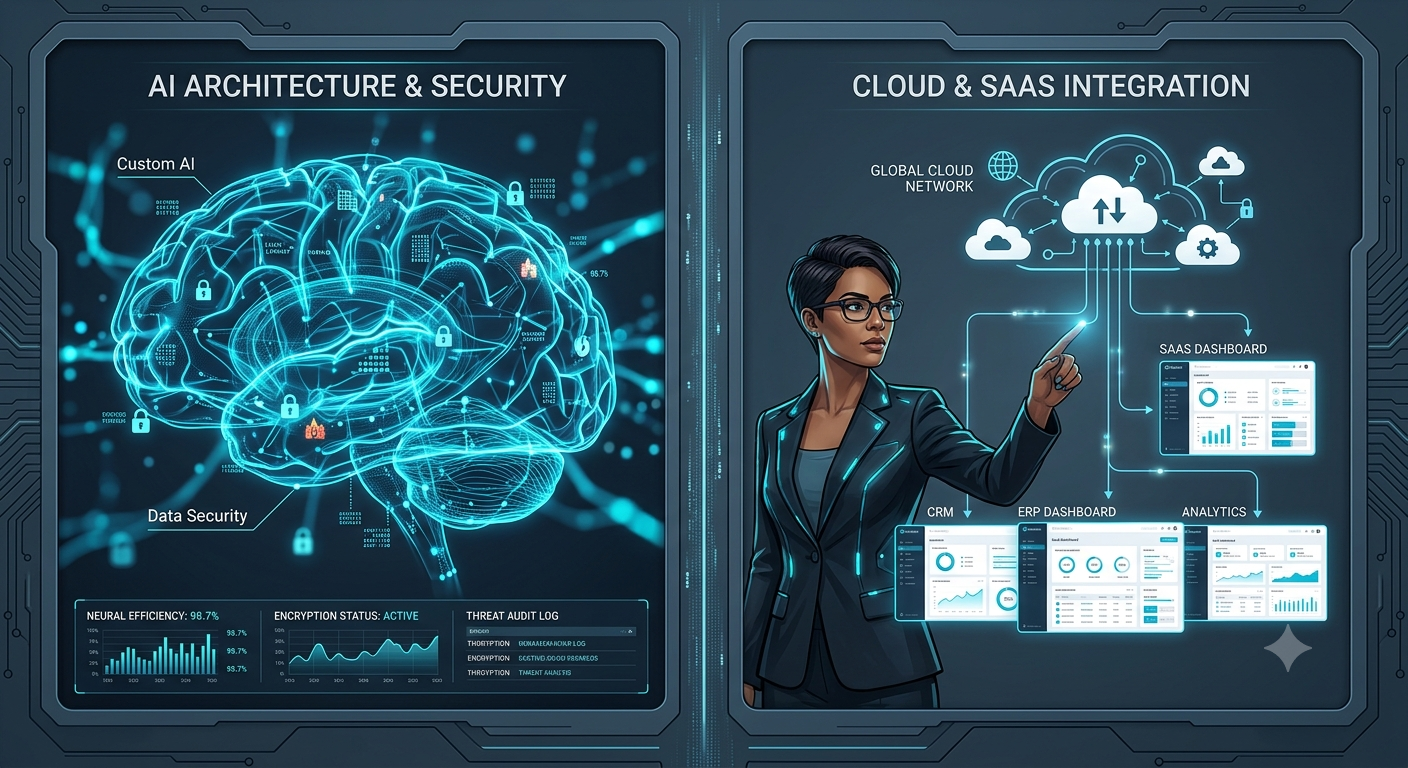
As artificial intelligence transforms enterprise sales strategies, executive leadership teams face a strategic crossroad: Should you license an established Cloud SaaS CRM or build a custom AI-driven CRM tailored precisely to your operational workflow?
Both approaches carry significant financial and operational trade-offs that impact long-term enterprise scalability and data security.
1. Cloud SaaS CRM Platforms: Turnkey Scalability
Off-the-shelf Cloud SaaS CRMs (such as Salesforce, Zoho, or HubSpot) offer instant infrastructure, continuous vendor updates, and pre-built integrations.
Key Advantages:
-
Rapid Deployment: Implementation schedules range from weeks to months, rather than years.
-
Predictable Operational Expenditure (OpEx): Fixed subscription pricing allows clear budget forecasting.
-
Continuous Innovation: Vendors invest heavily in rolling out native AI updates, patch management, and security protocols automatically.
Limitations:
-
Recurring Subscription Escalation: Costs scale significantly as user seats, storage, and premium API calls increase.
-
Workflow Constraints: Customizing proprietary SaaS architectures beyond their framework limits can become exceptionally expensive and fragile.
2. Custom AI-Powered CRM Software: Complete Ownership & Precision
Building a custom CRM or expanding an open-source enterprise engine with custom AI layers allows organizations to build proprietary algorithms around their specific customer journey.
Key Advantages:
-
Proprietary Data Advantage: Your customer interaction data trains an exclusive AI engine that competitors cannot replicate.
-
Zero License Fees at Scale: Eliminates per-user monthly SaaS charges for massive workforces.
-
Full Data Sovereignty: Essential for financial institutions, defense contractors, and healthcare organizations with strict data residency mandates.
Limitations:
-
High Initial Capital Expenditure (CapEx): Requires significant upfront investment in software engineering, UI/UX architecture, and security auditing.
-
Maintenance Overhead: Your internal engineering or IT vendor bears 100% of the responsibility for bug fixes, API updates, and server infrastructure.
3. Comparative Executive Matrix
| Decision Criteria | Cloud SaaS CRM Solutions | Custom AI-Powered CRM Software |
| Time to Market | Fast (1–3 Months) | Slow (6–18 Months) |
| Upfront Cost | Low | Very High |
| Scalability Cost | High (Per-seat pricing increases) | Low (Infrastructure costs only) |
| Data Privacy Control | Vendor Dependent | Absolute Data Sovereignty |
| Custom AI Capability | General Market Models | Specialized Proprietary Models |
Making the Strategic Choice
If your organization operates in a standard industry framework with fewer than 500 users, a high-tier Cloud SaaS CRM delivers the fastest time-to-value and lowest operational risk.
However, for large enterprises with unique business logic, strict regulatory demands, or massive sales forces, developing a Custom AI-Powered CRM System creates a long-term competitive moat and reduces lifetime software spend.